

Cyber insurance helps a small business pay for the costs that follow a data breach or cyberattack, such as forensic work, customer notification, legal fees, ransom-related losses and lost income. It is sold as a standalone policy or as an endorsement on a business policy. Price depends on your size, industry, data and security controls.
TL;DR
- Cyber insurance pays for the financial fallout of a breach or attack. It does not stop the attack, so it works best next to basic security habits.
- Small businesses are in the claims data: the NAIC reports average claim severity in the small to mid-sized segment of about $142,000 in 2025.
- Premiums depend on revenue, industry, the kind of data you hold and controls such as multi-factor authentication and backups. Only a real quote tells you your price.
- Coverage can arrive as an endorsement on a business policy or as a standalone policy. Compare limits, deductibles and exclusions, not just the premium.
- Texas owners, including home-based businesses and landlords who store tenant data, can start with a business insurance review.
Table of Contents
- Does a small business really need cyber insurance?
- What does cyber insurance cover?
- Is cyber coverage the same as a general liability policy?
- How much does cyber insurance cost for a small business?
- What affects your premium and your eligibility?
- What security measures will an insurer ask about?
- What about Texas businesses, home offices and landlords?
- How do you compare cyber quotes side by side?
- Where do you start if you are a Texas business owner?
- FAQ
- Sources
Does a small business really need cyber insurance?
If your business stores customer names, payment details, health or financial records, or relies on email, a cloud accounting tool or an online booking system to get paid, you hold something an attacker wants and you depend on systems that can go down. Size does not remove that exposure. It only means you have less cash and fewer staff to absorb the cost.
The national numbers show how common cyber coverage has become. The NAIC’s 2026 report on the U.S. cybersecurity insurance market says domestic cyber policies in force rose 33% to 5.84 million in 2025, while reported claims rose 20% to 56,323, more than six times the 2017 level. Claims are not rare events that only hit large companies.
The same report puts the average claim severity for the small to mid-sized enterprise segment at about $142,000 in 2025, down from roughly $215,000 in 2024. For a shop, clinic, contractor or property owner with a handful of employees, a six-figure loss is a business-ending number if nothing stands behind it.
What does cyber insurance cover?
Policies are usually described in two parts. Wording differs by carrier, so treat the list below as the common structure and read your own policy for the exact terms.
First-party coverage: your own losses
First-party coverage responds to costs your business pays directly after an incident. Typical items include:
- Forensic investigation to find out what happened and how far it spread
- Notifying affected customers and offering credit monitoring where required
- Data recovery and system restoration
- Business interruption, meaning income lost while systems are down
- Cyber extortion, including negotiation and payment related to a ransomware demand
- Crisis communication and public relations help
Third-party coverage: claims against you
Third-party coverage responds when someone else says your failure harmed them. Typical items include legal defense, settlements or judgments tied to a breach, and regulatory defense and some fines or penalties where the law and the policy allow them.
What is commonly excluded or limited?
Exclusions and sublimits are where small owners get surprised. Ask about these before you buy:
- Sublimits. A policy might carry a large overall limit but a much smaller cap on ransomware, social engineering or funds-transfer fraud.
- Waiting periods. Business interruption often starts only after a set number of hours of downtime.
- War or state-backed attack language. Some policies limit coverage for attacks attributed to nation states.
- Prior known incidents. Problems that began before the policy start date are generally not covered.
- Physical damage and property. A general business property policy and a cyber policy answer different questions, and neither fully replaces the other.
- Security-control conditions. Some policies tie coverage to controls you said you had, so your application answers matter.
Is cyber coverage the same as a general liability policy?
No. A general liability policy is built around bodily injury and property damage to other people. A data breach is neither. Many owners assume a business owner’s policy picks up a stolen laptop full of customer files or a ransomware lockout, and learn at claim time that it does not, or that only a small sublimit applies.
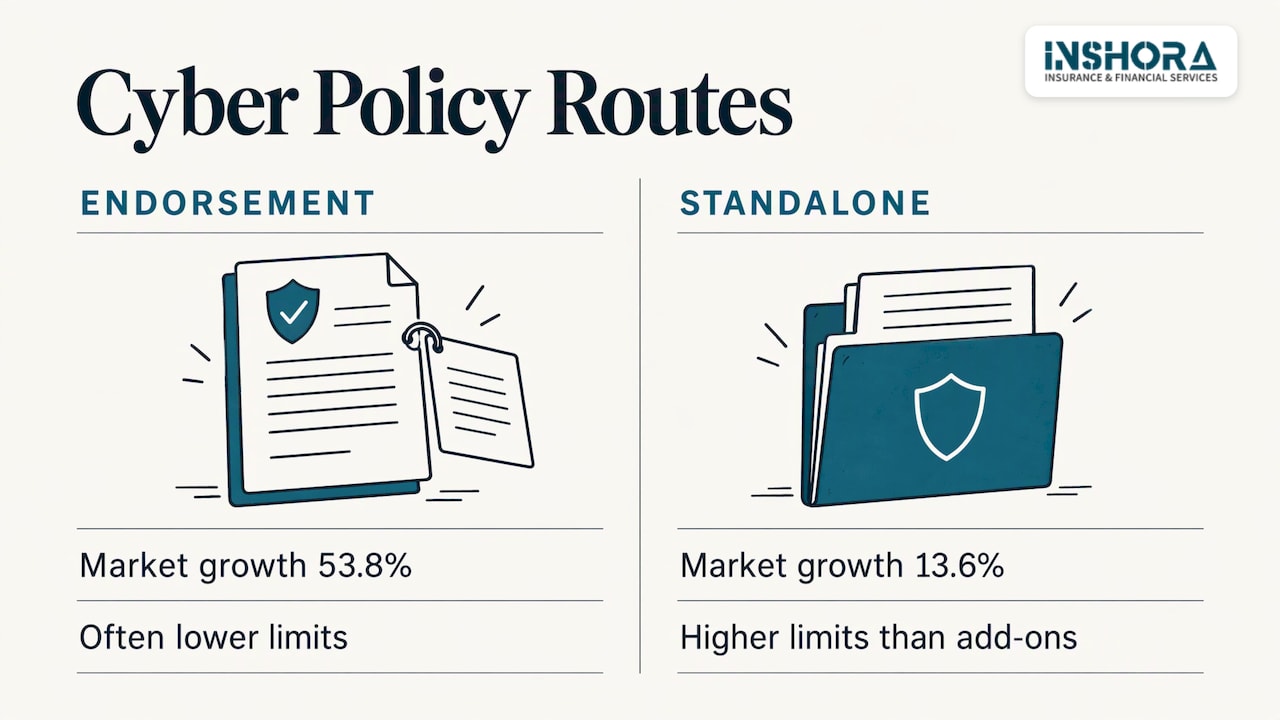
The NAIC report shows the market treats the two routes differently: endorsement policies grew 53.8% while primary, standalone policies grew 13.6%. Many small businesses get cyber protection as an add-on to a package they already carry. An add-on can be a convenient start, but its limits are often lower than a standalone policy, so compare the actual figures side by side.
How much does cyber insurance cost for a small business?
There is no single honest price. Cost moves with your revenue, industry, the number of records you hold, your claims history, the limit and retention you choose, and the security controls you can show. We do not publish a premium here because a figure without your details would be a guess.
What the official data does show is the direction of the market. The NAIC reports that total U.S. direct written cyber premium reached approximately $9.46 billion in 2025, up about 3.5% from $9.14 billion in 2024. It also reports that the industry-wide cyber loss ratio rose to 53 in 2025 from 48.7 in 2024, and that the first quarter of 2026 was the eighth consecutive quarter of U.S. cyber rate cuts. These are national market figures for those periods, not what a particular business will pay, and they shift with each annual report.
The practical takeaway: pricing is competitive, which makes comparing several carriers worth the effort.
A simple worked example
This is an illustration with made-up policy terms, not a quote. Say a policy has a $1,000,000 limit and a $10,000 retention (the amount you pay before the insurer pays). Suppose an incident costs $142,000, the NAIC’s 2025 average for the small to mid-sized segment, and every item is covered with no sublimit in the way.
| Item | Amount |
|---|---|
| Total incident cost (illustration) | $142,000 |
| Your retention | $10,000 |
| Paid by the policy | $132,000 |
Now imagine the ransomware portion of that loss sat under a $50,000 sublimit. The insurer would cap that part, and you would carry the rest. This is why the sublimit page of a policy matters as much as the headline limit.
What affects your premium and your eligibility?
Carriers want to know how likely you are to have a loss and how large it could be. Expect them to weigh:
| Factor | Why it matters |
|---|---|
| Annual revenue and headcount | Bigger operations have more to lose and more access points |
| Industry | Medical, legal, financial and retail businesses handle more sensitive data |
| Volume of records | More customer, patient or tenant records means a larger notification bill |
| Security controls | Multi-factor authentication, tested backups and patching reduce risk |
| Claims history | Prior incidents raise questions |
| Limit and retention | A higher limit costs more, a higher retention lowers the premium |
Eligibility is usually decided on the application. Be accurate. A coverage dispute after a claim often starts with an application answer that did not match reality.
What security measures will an insurer ask about?
Applications commonly ask about the same handful of basics. Getting these in place helps you qualify and can improve the terms you are offered:
- Multi-factor authentication on email, remote access and administrator accounts.
- Backups that are kept separate from your main network and that you have actually restored from in a test.
- Software updates applied on a regular schedule, including the devices staff use at home.
- Employee training on phishing and on verifying payment-change requests by phone.
- A written incident plan listing who to call first, including your insurer or agent.
If you have a claim, notify the carrier promptly and follow the policy’s reporting instructions before hiring outside help, since some policies require use of their approved responders.
What about Texas businesses, home offices and landlords?
Texas has its own breach notification requirements for businesses that hold residents’ sensitive personal information, so a breach can bring legal duties on top of the cleanup. Ask a qualified Texas attorney what applies to your situation, and ask your agent how a policy handles legal and regulatory costs.
Two Texas groups often overlook cyber exposure:
- Home-based businesses. A founder working from a spare room still keeps customer files, invoices and card data. Homeowners policies are built for the house and its contents, so a business running from home usually needs to review business coverage separately. Our guide for Texas founders working from home walks through what to look at.
- Landlords. If you manage rental homes, you may keep tenant applications, Social Security numbers, bank details and lease files in email or cloud folders. That is personal data a breach would expose. A landlord property policy covers the building, and a cyber policy is a separate question about your records.
How do you compare cyber quotes side by side?
A low premium can hide thin coverage. Put each quote in a table like this and fill it from the actual quote documents:
| Compare | What to look for |
|---|---|
| Aggregate limit | Is it enough for a six-figure incident with room to spare? |
| Sublimits | Ransomware, funds-transfer fraud, social engineering |
| Retention | The amount you must pay before coverage starts |
| Business interruption waiting period | How many hours before income loss is covered |
| Form | Standalone policy or endorsement on a business policy |
| Response services | Who handles forensics, notification and legal help |
| Exclusions | War, prior incidents, unencrypted devices, unmet security conditions |
Compare three to five quotes on the same limit and retention so the differences are real. Our list of questions to ask your business insurance agent works for this conversation, and our overview of what to look for in a business insurance plan helps you judge the rest of the package.
Where do you start if you are a Texas business owner?
Inshora Group is an independent agency in Sugar Land that compares coverage from more than 25 carriers, so one conversation can put several options in front of you instead of one. Tell us what your business does, what data you hold and how you work, and we can review your business insurance needs with you.

When you are ready, the business insurance quote form is the quickest way to begin. If you are still deciding which policies a small business needs overall, our guide to the best insurance for a small business in Texas lays out the options.
FAQ
Is cyber insurance worth it for a very small business?
If you store customer data or depend on online systems to take payments, one incident can cost more than a small firm has in reserve. The NAIC’s 2025 average for the small to mid-sized segment was about $142,000 per claim. Insurance transfers part of that cost to a carrier.
How much is cyber insurance?
It depends on your revenue, industry, data and security controls, plus the limit and retention you pick. Nationally, the NAIC reports cyber rates fell for eight straight quarters through early 2026, but that is a market trend, not your price. A quote based on your details is the only accurate answer.
Does a business owner’s policy include cyber coverage?
Sometimes a policy includes a small cyber endorsement, and often it does not. Even when included, limits and sublimits may be modest. Read the endorsement itself and compare it with a standalone quote before you decide it is enough.
What should I do first if my business is hit by a cyberattack?
Contain the problem by disconnecting affected devices, then contact your insurer or agent right away so the policy’s reporting steps are followed. Keep records of what happened and what you spent. For legal duties to notify customers, talk to a Texas attorney.
