

General liability insurance covers claims that your business caused someone else bodily injury, property damage, or personal and advertising injury, such as libel or copyright infringement. It can also pay legal defense costs and settlements. It does not cover your own property, your employees’ injuries, or professional mistakes. Those need separate policies.
TL;DR
- General liability (often called commercial general liability, or CGL) protects your business against third-party claims for bodily injury, property damage, and personal and advertising injury.
- It excludes injuries you intended, your employees’ work injuries, professional errors, auto liability, pollution, and damage to your own work or to property in your care.
- Limits matter: a common contract request is $1 million per occurrence and $2 million aggregate, and a small policy can fall short of that.
- Whether the policy responds depends on its type: occurrence or claims-made.
- Texas has no blanket rule that you need it, but leases, contracts, and clients often do. We compare quotes from more than 25 carriers for Texas businesses and rental property owners.
Table of Contents
- What does general liability insurance actually cover?
- How does a general liability claim work?
- What does general liability not cover?
- Is general liability insurance required in Texas?
- How much general liability coverage do you need?
- What should landlords and rental property owners know?
- How do you compare general liability quotes?
- Can Inshora Group help you compare general liability coverage?
- FAQ
- Sources
What does general liability insurance actually cover?
The Texas Department of Insurance (TDI) describes commercial general liability as protection for business owners against claims of liability for bodily injury, property damage, and personal and advertising injury. The FDIC’s small business guide adds that it typically includes medical payments, and may cover legal fees and settlements.
In plain terms, it answers one question: if someone outside your business says you caused them harm, who pays?
| Coverage part | What it means | Texas-style example |
|---|---|---|
| Bodily injury | Medical costs and liability when a customer, visitor, or vendor is hurt | A customer slips on a wet floor at your Katy shop |
| Property damage | Damage you cause to someone else’s property | Your crew floods a client’s kitchen in Sugar Land |
| Personal and advertising injury | Claims such as slander, libel, or copyright infringement in your marketing | A competitor says your ad copied its copyrighted photo |
| Medical payments | Small no-fault payments for injuries on your premises | A visitor needs stitches after tripping on your step |
| Legal defense | Attorney fees and settlements for a covered claim | A lawsuit follows the customer’s fall |
The examples are illustrations, not claims history. Whether a specific loss is covered depends on the policy wording, which is why the declarations page and endorsements matter.
What are premises and products coverage?
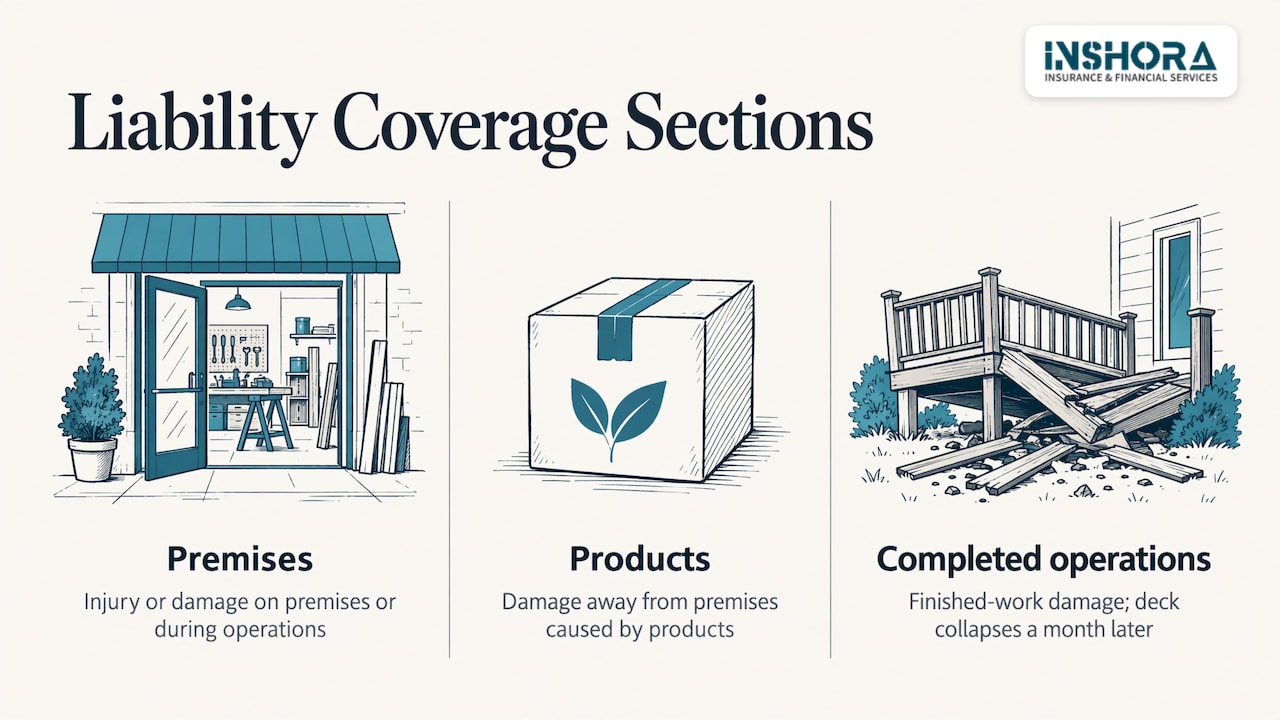
TDI explains two core pieces. Premises and operations coverage pays for injury or damage that happens on your premises or from your business operations. Products and completed operations coverage pays for damage away from your premises caused by your products or by work you have finished.
The California Department of Insurance describes the same three sections: premises liability, products liability, and completed operations. If you finish a deck and it collapses a month later, completed operations is the part that responds.
How does a general liability claim work?
A third party makes a claim, you report it to your carrier, and the carrier investigates and defends it if the claim falls inside the policy. The timing rule depends on which of two policy types you hold, according to TDI:
| Occurrence policy | Claims-made policy | |
|---|---|---|
| What triggers coverage | Injury or damage happens while the policy is in force | Both the injury and the report fall within the policy period |
| Claim filed after the policy ends | Still covered if the event happened during the policy | Not covered unless you buy prior-acts or run-off coverage |
| Extra coverage to ask about | Usually none needed | Prior acts (“nose”) and run-off (“tail”) |
On a claims-made policy, prior acts coverage is set by a retroactive date on the declarations page, and it does not cover claims you already knew about when the policy began. TDI says run-off coverage typically follows a 30- or 60-day reporting period and can extend one, three, or five years, or be unlimited, for an additional premium.
If you are switching carriers, ask which type you have now and which type you are buying. A gap between the two is a common way a covered-sounding loss ends up unpaid.
What does general liability not cover?
This is the part most owners learn too late. The Wisconsin Office of the Commissioner of Insurance names the most important exclusion: injury or property damage that you intended or expected. It also lists exclusions for workers’ compensation, professional liability, auto liability, property in your care, custody and control, contract losses, nuclear radiation, and pollution claims, which need a special policy. TDI adds damage to your own work (with an exception for work done by subcontractors) and workers’ compensation and employer’s liability.
| Exposure | Covered by general liability? | What usually covers it |
|---|---|---|
| Customer injured on your premises | Yes, subject to terms | General liability |
| Employee injured on the job | No | Workers’ compensation |
| Advice or design error that costs a client money | No | Professional liability |
| Accident in a company vehicle | No | Commercial auto |
| Stolen customer data | No | Data breach coverage |
| Fire or storm damage to your own building and equipment | No | Commercial property |
| Pollution cleanup | No | Special pollution policy |
| Wrongful termination, harassment, discrimination | No | Employment practices coverage |
The Wisconsin guide confirms that general liability will not protect against nonperformance of a contract, wrongful termination, sexual harassment, or discrimination lawsuits. The FDIC notes that a business owner’s policy (BOP) does not include workers’ compensation, professional liability, commercial auto, or data breach insurance.
Another point from Purdue Extension: policyholders should pay attention to the contracts they sign with customers, because assumed liability is an area where exclusions and exceptions apply. Read the indemnity clause in a contract before you sign it.
The California Department of Insurance stresses that a CGL policy has major exclusions and advises owners who do not understand them to talk to their broker-agent. That conversation is a good use of an independent agent’s time.
Is general liability insurance required in Texas?
Not as a general condition of doing business, in the sense of a single rule for every company. In practice, the requirement usually comes from someone else: a commercial landlord, a general contractor, a client’s vendor rules, or a license. Check your license or lease terms, and see our guide on requirements for commercial business insurance in Texas.
Contract requirements follow a pattern. In Hawaii, for example, state contracts require $1 million per occurrence and $2 million aggregate, with the state named as an additional insured on the certificate of insurance. The state’s risk manager describes the purpose as risk transfer: the vendor’s insurance pays if someone is hurt or property is damaged because of the vendor’s work, so public money does not have to. Texas clients and landlords use the same logic, even if their numbers differ. Treat the Hawaii figures as an example of how contract language works, not as a Texas rule.
The FDIC describes general liability as one of the few coverages most small businesses start with, often through a BOP that packages liability and property coverage together.
How much general liability coverage do you need?
Start with what your contracts demand, then add a margin for the way you work. TDI advises reviewing the policy and its endorsements and talking to an agent about coverage and limits. It also notes that excess liability pays covered losses above your CGL limit.
What do the limits on a policy mean?
The Wisconsin guide breaks down how BOP limits are structured:
- A single limit for liability and medical expenses, with a separate medical expenses limit per injured person.
- Separate limits for products and completed operations, and for advertising and personal injury.
- A general aggregate limit, which caps what the policy pays in total during the policy period.
- Per-occurrence limits, which cap any one event.
Its worked example uses a $500,000 liability limit with a $5,000 per-person medical limit. A BOP’s single limit makes the buying decision simpler but reduces flexibility. A business with higher-than-average product risk, such as a toy maker, may need higher limits or an umbrella or excess policy.
Is $1 million enough?
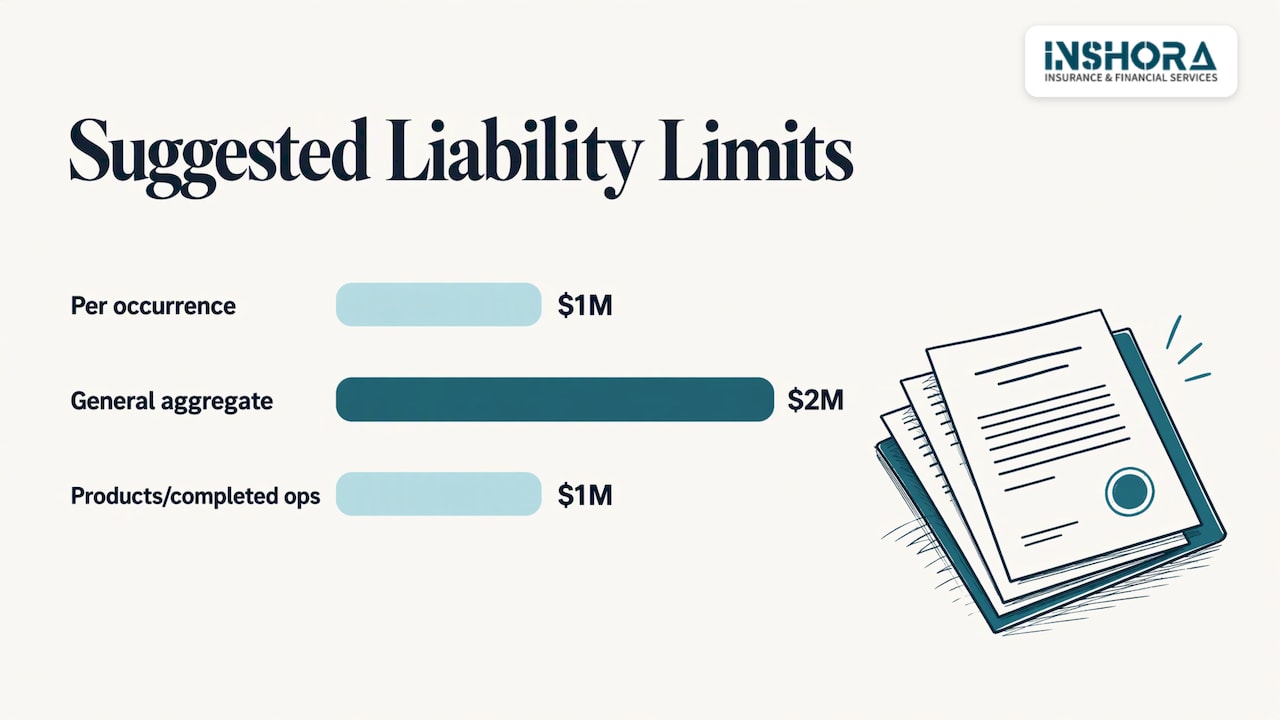
It is the usual starting figure in contracts, but not always the finish line. A claims-industry presentation from the International Claims and Settlements Conference argues that $1,000,000 is never enough given modern judgments. It suggests contracts require $1 million per occurrence with a $2 million general aggregate and a $1 million products and completed operations aggregate, and that they use wording like “no less than” so a carrier cannot cap coverage at the contract minimum. That is one professional’s view of contract drafting, so treat it as a prompt for questions rather than a rule.
A simple way to think about it:
- List every contract, lease, and license that names a minimum limit. The highest one is your floor.
- Ask how much a serious injury or a damaged client building could cost you in your trade.
- If the answer exceeds the floor, price a higher limit or an umbrella policy, which sits above the basic liability limit.
- Check whether the aggregate resets each policy year or applies per project or location.
We do not publish premiums for general liability, because they depend on your trade, payroll or sales, location, and claims history. Any number you see online is a sample, never a quote.
What should landlords and rental property owners know?
If you own rental houses in Sugar Land, Richmond, or Houston, you have a liability exposure much like a small business does: a tenant’s guest trips on a cracked walkway and blames you. The coverage sits in a different kind of policy. Rental property owners typically use a landlord policy rather than a stand-alone business general liability policy, and the liability terms differ by form and carrier.
Questions to put to your agent:
- Does the policy include liability for injuries to tenants and visitors, and at what limit?
- Does it cover the structure only, or also detached garages and fences?
- If you run your rentals through an LLC or a property management business, is a separate business liability policy appropriate?
- How are flood losses handled? Standard property and liability forms generally do not treat flood as a covered cause, so landlords in flood-prone parts of Texas should ask about a separate flood policy.
Good records also make claims easier to defend. Photo documentation of a unit’s condition at move-in and move-out is the kind of evidence that settles disputes, and a guide to digital evidence preservation for rental properties explains how to keep it organized.
For the landlord side, see our rental home insurance overview.
How do you compare general liability quotes?
Two quotes with the same price can protect you very differently. Compare these items line by line. The IIAT’s commercial lines checklist is a good reminder of how much detail sits in endorsements: property of others, leased property limits, separate project or premises limits, employment practices and products exclusions, additional insured and liquor liability endorsements.
| What to compare | Why it matters |
|---|---|
| Occurrence or claims-made | Decides whether a late claim is covered |
| Per-occurrence and aggregate limits | Must meet contract minimums |
| Products and completed operations limit | Critical for contractors and product sellers |
| Additional insured endorsement | Landlords and clients often require it |
| Deductible or self-insured retention | Your cost before the carrier pays |
| Exclusions and endorsements | Where most coverage gaps hide |
| Medical payments limit | Handles small injuries without a lawsuit |
If you do contract work, our page on contractor insurance coverage covers what trades usually need. For a wider view, our guide to the best insurance for a small business in Texas shows where general liability sits next to workers’ compensation, property, and other coverages. Before you meet an agent, the 10 questions to ask a business insurance agent will keep the conversation specific.
Can Inshora Group help you compare general liability coverage?
Inshora Group is an independent insurance agency in Sugar Land, Texas. We compare coverage options from more than 25 carriers, so you can see limits, deductibles, and exclusions side by side rather than judging one company’s form alone. Our business insurance team can walk you through general liability, and our rental home insurance page is there for landlords.
To start, send your business details through the business insurance quote form and tell us which contracts or leases set your minimum limits.
FAQ
What is the difference between general liability and business insurance?
General liability is one coverage inside the wider category of business insurance. It handles third-party injury, property damage, and advertising injury claims. Business insurance as a whole can also include property, workers’ compensation, professional liability, commercial auto, and cyber coverage, which general liability does not replace.
Does general liability cover my employees?
No. The Wisconsin OCI guide lists workers’ compensation as excluded from general liability and BOP liability coverage. Employee injuries go under workers’ compensation or employer’s liability, which TDI also lists as an exclusion.
Does general liability pay legal fees?
It can. The FDIC states that general liability may cover legal fees and settlements for covered claims. Whether defense costs sit inside or on top of your limit depends on the policy, so confirm that with your agent.
Is a business owner’s policy the same as general liability?
No. A BOP typically bundles general liability with commercial property coverage. The Wisconsin OCI notes that its single limit simplifies buying but reduces flexibility, and that higher-risk businesses may want higher limits or an umbrella policy.
What is the difference between occurrence and claims-made?
An occurrence policy covers events that happen while it is in force, whenever the claim is filed. A claims-made policy requires both the event and the report to fall within the policy period, unless you buy prior-acts or run-off coverage, per TDI.
Sources
- Texas Department of Insurance: Commercial general liability insurance
- FDIC: Module 11 Insurance, Participant Guide
- Wisconsin OCI: Consumer’s Guide to Insurance for Small Business Owners
- California Department of Insurance: Commercial insurance guide
- Purdue Extension: The Insurance Policy, PPP-49
- Hawaii State Procurement Office: SPO 150, Insurance Requirements for Contracts
- International Claims and Settlements Conference: drafting insurance language
- IIAT: Commercial Lines Coverage Checklist
- RentalLiability: digital evidence preservation
