

The Texas Department of Insurance (TDI) reports a 2025 statewide average homeowners premium of $3,489 a year. Houston quotes vary widely around that figure because ZIP code, roof, rebuild cost, deductible and claims history all change the price. Your own quote, not an average, is the number that matters.
TL;DR
- The TDI market overview puts the 2025 Texas average homeowners premium at $3,489 a year, about $291 a month. Houston addresses can land well above or below it.
- Filed rates are moving down for many Texans: TDI says homeowners rate changes filed over 90 days averaged a 4.3% decrease (report dated October 8, 2026).
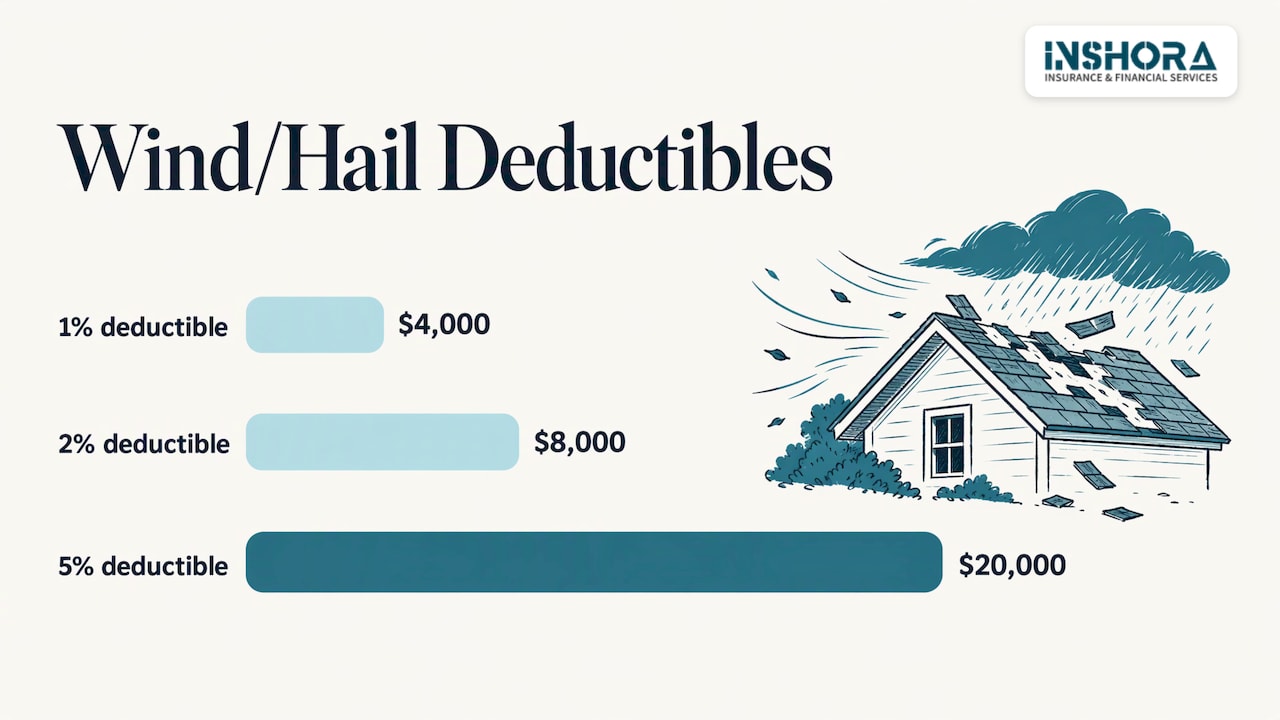
- The wind/hail deductible is often a percentage of your dwelling limit. On a $400,000 dwelling limit, 1%, 2% and 5% mean $4,000, $8,000 and $20,000 out of pocket.
- Standard homeowners policies do not cover flood. In Houston, flood coverage is a separate decision for owners and landlords alike.
- Compare coverage, deductible and price together. The cheapest quote is often the one that covers less.
Table of Contents
- What does home insurance cost in Houston on average?
- How much should home insurance cost on a $400,000 house?
- Why is home insurance so expensive in Houston?
- Are Houston home insurance rates going up or down?
- How do wind and hail deductibles change what you really pay?
- Replacement cost or actual cash value: which pays more?
- Does homeowners insurance cover flooding in Houston?
- What should Houston landlords know about property and flood coverage?
- How do you compare Houston home insurance quotes fairly?
- How can you lower your Houston home insurance cost?
- Where does Inshora Group fit in?
- FAQ
- Sources
What does home insurance cost in Houston on average?
There is no single official Houston average, so start with the number TDI publishes for the whole state. Its homeowners market overview reports a 2025 average annual premium of $3,489 across 8,233,096 active policies, with $19.75 billion in direct written premium and 157 companies writing coverage.
That statewide figure is a useful anchor, not a prediction. It blends small inland homes with large coastal ones. A Houston homeowner should treat it as the middle of a wide range and expect the final quote to move up or down based on the house.
Here is how the average converts to a monthly budget:
| Annual premium | Monthly equivalent | What it represents |
|---|---|---|
| $2,400 | $200 | The “$200 a month” budget many readers ask about |
| $3,489 | $290.75 | TDI’s 2025 Texas average premium |
The monthly column is simple arithmetic (annual premium divided by 12), not a quote. A $200 monthly budget works out to $2,400 a year, which is below the 2025 statewide average. Whether that buys enough coverage in Houston depends on the home, and the sections below show what to check.
How much should home insurance cost on a $400,000 house?
No reliable public source gives a Houston premium for a $400,000 home, so we won’t invent one. What we can do is show what drives the number.
Two different values get mixed up here:
- Market value is what the house would sell for, including the land.
- Replacement cost is what it would cost to rebuild the structure today, with current labor and materials.
Your dwelling limit (Coverage A) should be based on the rebuild cost, not the sale price. A $400,000 Houston house could cost more or less than that to rebuild, depending on size, finishes and construction. That is why two neighbors with the same purchase price can get different premiums.
TDI’s consumer guide, Shopping smart: Tips for buying auto and home insurance, lists what homeowners premiums can reflect: the home’s age and condition, replacement cost, construction materials, location, fire protection, claims history and credit score. It also warns that a cheaper policy may provide less coverage, so compare policies apples to apples.
Why is home insurance so expensive in Houston?
Texas premiums are shaped by the same factors that apply to every homeowner, plus Gulf Coast weather exposure. Houston homes face hail, wind, heavy rain and hurricane-season storms. The TDI guide above names location and construction materials as pricing factors, and insurers price for the weather risk in each area.
Several personal factors also change a Houston quote:
- Roof age and material. An older roof is a larger wind and hail risk.
- Home age and condition. Older plumbing, wiring and systems can raise the price.
- Rebuild cost. Higher labor and material costs lift the dwelling limit and the premium.
- Claims history. Past claims on the property or by you can affect pricing.
- Credit history. TDI notes that most insurers use credit information where permitted.
- Location. Two ZIP codes in the same city can price differently.
You can change some of these, such as a roof replacement or a higher deductible. You can’t change others, such as your address. That is why getting quotes from several carriers matters: each company weighs these factors differently.
Are Houston home insurance rates going up or down?
Recent state data points down for many filings, though your renewal can differ. TDI’s October 8, 2026 release, Home and auto insurance rates trending down for many Texans, says most homeowners rate filings since July 1 proposed decreases affecting about 700,000 policyholders. Filed homeowners rate changes averaged a 4.3% decrease over 90 days.
The same release names two large filings: ASI Lloyds (Progressive) filed a 6% decrease affecting 71,000 policyholders, and Texas Farm Bureau filed a 5.2% decrease affecting 133,000.
The market overview page adds that filed rate requests averaged -4.0% over August to October 2026 and 0.3% over the 30-day window in October 2026. These figures update as companies file, so read them as snapshots for those periods.
A filing is a request by a company to change its base rates. It does not guarantee your premium will fall, because your own renewal also reflects your home’s rebuild cost, claims and deductible choices. You can look up filings yourself on TDI’s rate filing search page.
How do wind and hail deductibles change what you really pay?
In many Texas policies, the wind and hail deductible is a percentage of your dwelling limit, not of the damage. That makes it one of the biggest swings in what a Houston claim costs you. A lower premium with a high percentage deductible can leave you with a large bill after a storm.
The table below is a mathematical example for a home with a $400,000 dwelling limit. It is not a quote, and your policy’s deductible options will differ.
| Wind/hail deductible | Formula | You pay first | Example: $15,000 roof claim | Insurer pays toward loss* |
|---|---|---|---|---|
| 1% | $400,000 × 0.01 | $4,000 | You pay $4,000 | $11,000 |
| 2% | $400,000 × 0.02 | $8,000 | You pay $8,000 | $7,000 |
| 5% | $400,000 × 0.05 | $20,000 | You pay the full $15,000 | $0 |
*Before any other policy terms, and assuming the loss is covered.
Two lessons come out of the math. First, at 5% the same $15,000 hail claim falls entirely below the deductible, so the policy pays nothing. Second, a higher deductible lowers your premium but raises your out-of-pocket cost, which is the trade-off TDI describes on its rate filing page.
A practical test: could you pay the deductible from savings within a week of a storm? If a 5% deductible would strain your budget, ask for quotes at 1% and 2% too, and compare the premium difference to the dollar difference above.
Replacement cost or actual cash value: which pays more?
Replacement cost coverage pays to repair or replace damaged property at today’s prices. Actual cash value pays the replacement price minus depreciation for age and wear. On an older Houston roof, the gap can be large, because depreciation reduces the check.
Here is a simple illustration, again as math and not a quote:
| Item | Replacement cost basis | Actual cash value basis |
|---|---|---|
| New roof cost | $15,000 | $15,000 |
| Depreciation for age (example: 50%) | none | -$7,500 |
| Before deductible | $15,000 | $7,500 |
Policies can apply these terms differently to the dwelling, to personal property and to roofs, so read each line of the declarations page. Ask every carrier how the roof is paid, because that is the part of a Houston claim most often affected.
Does homeowners insurance cover flooding in Houston?
No. A standard homeowners policy does not cover flood damage, so flood is a separate policy. In a city built around bayous and prone to heavy rain, that decision belongs in any Houston cost discussion. Ignoring it can make a cheap homeowners premium look better than it is.
What do FEMA flood zones mean?
FEMA maps divide land into flood zones that show relative risk. Zones beginning with A or V are high-risk areas, called Special Flood Hazard Areas. Mortgage lenders typically require flood coverage for homes in those areas. Zones such as X are lower risk, but lower risk does not mean no risk, and homes outside high-risk zones also flood.
You can look up your address on FEMA’s map service center. Your zone is one input to a flood quote, alongside elevation, foundation type and building age. Our guide to flood insurance costs in Houston walks through what moves those prices.
NFIP or private flood insurance: how do they compare?
The National Flood Insurance Program (NFIP) is the federal program, and private flood policies come from insurance companies. Compare them on the same checklist:
| What to compare | NFIP | Private flood |
|---|---|---|
| Who backs it | Federal program | Private insurance company |
| Coverage limits | Set by the program | Set by each company, which can differ |
| Pricing | Set by program rules | Set by each company, so quotes vary |
| Waiting period | Check the policy | Check the policy, which can differ |
| Where to compare | One program | Several carriers side by side |
Because private terms differ between companies, an agency that quotes several carriers can lay the options out together. Our flood insurance page explains how we compare them, and the top flood insurance questions page covers waiting periods and common claims questions.
What should Houston landlords know about property and flood coverage?
A rental house needs a different policy from the one you live in. A homeowners policy is written for an owner-occupied home. A landlord policy (often called dwelling fire or rental dwelling coverage) is written for a property you rent to someone else, and it protects the structure and your liability as owner.
For a Houston rental, check these points:
- Structure and rebuild cost. Insure the building at rebuild cost, as you would your own home.
- Wind/hail deductible. The same percentage math applies. On a $250,000 rental dwelling limit, 2% is $5,000 (math example), and you pay it out of rental income.
- Flood. A landlord policy does not replace flood coverage. A rental in a flood-prone area needs its own flood policy for the building.
- Tenant belongings. Your policy does not cover your tenant’s property. Tenants need renters insurance, which our renters insurance page explains.
- Lost rent. Ask whether loss of rental income is included if a covered event makes the home uninhabitable.
Our rental home insurance page covers landlord property coverage in Texas, and the rental home overview explains the policy in more detail.
How do you compare Houston home insurance quotes fairly?
A fair comparison keeps everything the same except the company. Otherwise a lower price may simply reflect lower limits or a higher deductible. TDI’s guidance to compare policies apples to apples is the right rule.
Use this checklist on every quote:
- Same dwelling limit (Coverage A), based on rebuild cost.
- Same all-other-perils deductible (for example, $2,500).
- Same wind/hail deductible, shown as both a percentage and a dollar amount.
- Same roof payment basis, replacement cost or actual cash value.
- Same liability and personal property limits.
- Same discounts applied, such as multi-policy, which TDI says to ask about.
- Flood handled separately, with its own quote.
Putting terms side by side is the hard part when quotes arrive in different formats. Comparing quote terms side by side shows why matching the terms matters before you look at price. Our guide to comparing homeowners and flood insurance applies the same approach to Texas policies.
How can you lower your Houston home insurance cost?
TDI’s advice is consistent: shop regularly, compare policies sold in your area, ask about discounts and choose deductibles wisely. Its rate filing page says higher deductibles lower premiums but raise your out-of-pocket claim cost.
Steps that tend to matter most:
- Shop at renewal. Rates and filings change, so last year’s best carrier may not be this year’s.
- Ask about multi-policy discounts. If you also insure vehicles, our home and auto bundle guide explains how bundling works in Texas.
- Choose the deductible deliberately. Use the table above to see the dollar exposure, not just the percentage.
- Keep the roof in good shape. Roof age and condition are named pricing factors.
- Review the dwelling limit. Insure for rebuild cost so you are neither overpaying for too much nor exposed with too little.
Where does Inshora Group fit in?
Inshora Group is an independent insurance agency in Sugar Land, serving Houston, Katy, Richmond and Cypress. We compare homeowners, flood and rental property coverage options from over 25 carriers, so you see coverage, deductibles and prices lined up instead of one company’s single offer. Clients frequently report savings of over $600 a year on average.

Start with our Texas homeowners insurance quotes page, or use the home insurance quote form to request a comparison for your address. Mention your roof age, your preferred wind/hail deductible and whether you need flood coverage, so every quote is built on the same terms. Landlords can start from our rental home insurance page.
FAQ
Is $200 a month a lot for home insurance in Houston?
$200 a month is $2,400 a year, which is below TDI’s 2025 statewide average premium of $3,489. Whether it is enough or too little depends on your home, deductible and coverage. Compare it only against quotes with the same limits and deductibles.
Who has the cheapest homeowners insurance in Houston?
There is no single answer, because each company weighs your roof, location, claims history and credit differently. The cheapest quote for your neighbor may not be the cheapest for you. An independent agency can quote several carriers on the same terms so you can see the real difference.
Does the average Houston premium include flood insurance?
No. Standard homeowners premiums do not include flood coverage, so flood is priced separately. Add a flood quote when you budget for your home, especially if you live in or near a high-risk FEMA zone or own a rental property.
Do landlords in Houston need a different policy than homeowners?
Yes. A rental property needs landlord coverage written for a home you do not live in, and it does not cover your tenant’s belongings. Flood is also a separate policy for the building. Ask for both quotes at once.
Are Texas homeowners insurance rates falling?
Some are. TDI reported on October 8, 2026 that filed homeowners rate changes averaged a 4.3% decrease over 90 days. Your own renewal can still differ, so compare quotes before you renew.
Sources
- Texas homeowners insurance market overview, Texas Department of Insurance
- Shopping smart: Tips for buying auto and home insurance, Texas Department of Insurance
- Home and auto insurance rates trending down for many Texans, Texas Department of Insurance, October 8, 2026
- Search home and auto insurance rate filings, Texas Department of Insurance
