

A home and auto insurance bundle means buying your homeowners and auto policies from the same insurer, usually for a multi-policy discount. The two stay separate policies, each with its own coverage and deductible. Bundling is worth it only when the combined price and the home coverage both beat what you could assemble separately.
TL;DR
- Bundling means buying two or more policies, such as homeowners and auto, from one company, typically for a discount, easier billing and sometimes a single deductible for one event (NAIC).
- A cheaper bundle is not automatically a better one. Regulators note that shoppers may decide on price rather than coverage, so compare the home policy line by line.
- In Texas, check the wind/hail deductible (often a percentage of your dwelling limit), replacement cost vs. actual cash value, and whether flood is covered at all. Standard homeowners policies do not cover flood.
- Landlords can apply the same logic to a rental home, with a dwelling-fire or landlord policy and a separate flood decision.
- Always compare the bundled total against the best separate quotes. An independent agency can price both routes at once.
Table of Contents
- What does it mean to bundle home and auto insurance?
- What are the real advantages of bundling?
- What are the downsides of bundling?
- How much can you save by bundling?
- How do Texas wind and hail deductibles change a bundle?
- Replacement cost or actual cash value: which belongs in your bundle?
- Does a bundle cover flood? FEMA zones, NFIP and private flood
- What if you own a rental home in Texas?
- How do small claims and deductibles affect your renewal?
- Are there rules about how bundles are sold?
- How do you compare a home and auto bundle step by step?
- How does Inshora help you compare a bundle?
- FAQ
- Sources
What does it mean to bundle home and auto insurance?
Bundling is purchasing several types of insurance, such as homeowners and auto, from the same company in exchange for a discount. The National Association of Insurance Commissioners (NAIC), the group of state insurance regulators, describes it this way and adds that some insurers offer a combined deductible when one event damages more than one insured asset (NAIC, bundling).
Two points matter right away:
- You still have two policies. The home policy has its own limits, deductibles and exclusions. So does the auto policy. The bundle changes who issues them and how they are priced, not what each one covers.
- Not every insurer offers every feature. The combined deductible, for example, is something some carriers offer, not a rule.
This article focuses on the homeowners side, because that is where Texas bundles are most often won or lost: wind and hail deductibles, roof terms and flood gaps.
What are the real advantages of bundling?
The NAIC lists the main benefits as discounts, simpler policy and bill management, and in some cases one deductible for multiple assets damaged in the same event (NAIC). In practice for a Texas household that means:
- One renewal date and one point of contact instead of two.
- A multi-policy discount applied to one or both policies. The size varies by insurer, and the only number that matters is the quote you receive for your own house, vehicles and ZIP code.
- Fewer billing mistakes, such as a lapse on one policy because a payment went to the wrong place.
What are the downsides of bundling?
The same NAIC page points out that buying separately can give you more options and flexibility, and that consumers evaluating bundles may focus on price over coverage (NAIC). The practical risks are:
- A discount on a weak home policy. A bundle with a high percentage wind/hail deductible or actual cash value roof settlement can look cheap and cost you far more after a storm.
- Being tied to one insurer’s renewal pricing. If the home rate rises, you may feel pressure to leave the auto policy in place for the discount.
- Missing coverage. Flood is the biggest example in Texas, and bundling does not add it.
The fix is simple: compare the bundle against separate quotes, and compare coverage first, price second.
How much can you save by bundling?
No single savings figure applies to everyone. Published percentages come from individual insurers and websites with different methods, and your discount depends on the carrier, your claims history, your home’s age and roof, and your vehicles and drivers. Rather than quote a number you cannot rely on, use a method you can verify with your own quotes.
Worked example (sample numbers, not a quote or a rate):
| Scenario | Home | Auto | Total per year |
|---|---|---|---|
| Bundle from Carrier A | $2,400 | $1,600 | $4,000 |
| Best separate: Home from Carrier B, Auto from Carrier C | $2,100 | $1,500 | $3,600 |
In this made-up case, the bundle costs $400 more than the separate policies, even with a discount built in. The reverse is just as possible. The only way to know is to price both routes with identical coverage. That is the comparison an independent agency is set up to run: we compare options from more than 25 carriers, so you see the bundled and unbundled totals side by side.
How do Texas wind and hail deductibles change a bundle?
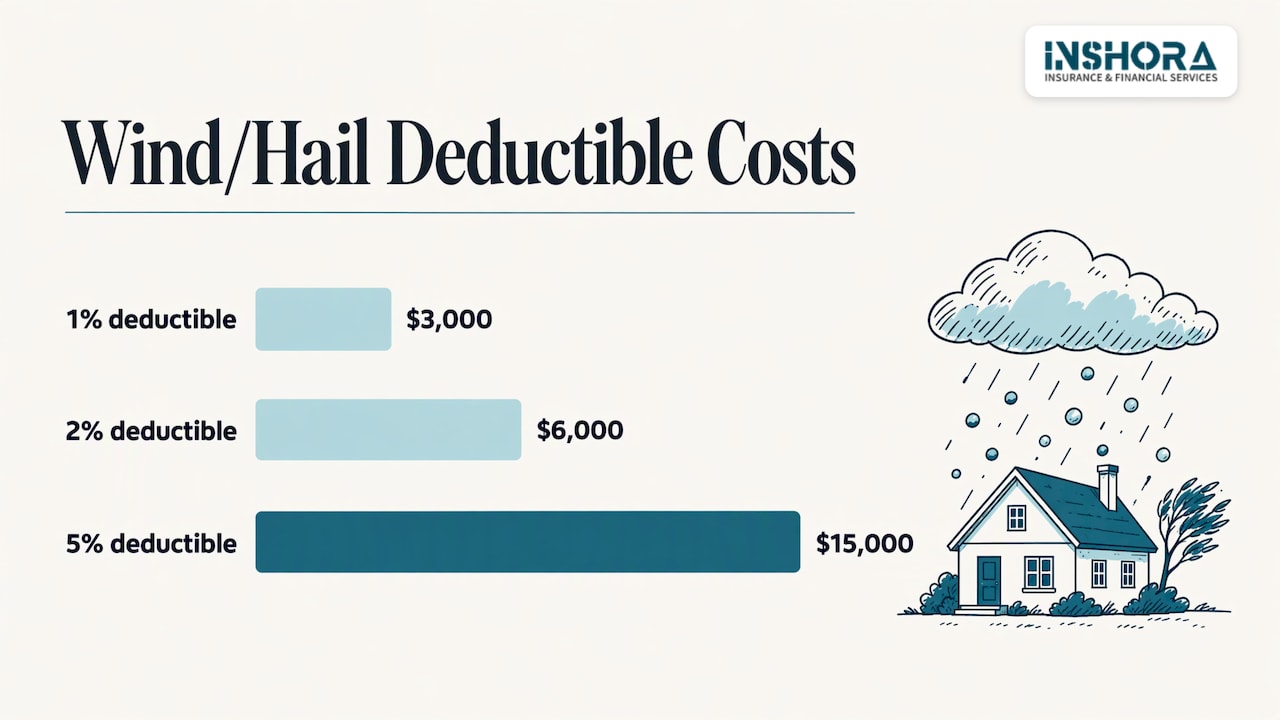
This is the part of a Texas home policy that most often surprises owners. Many policies set the wind/hail deductible as a percentage of your dwelling (Coverage A) limit rather than a flat dollar amount, so a policy with a low premium may carry a very large out-of-pocket amount after a hailstorm. Ask each carrier for the exact wind/hail deductible and whether it is a percentage or a flat amount.
Mathematical example for a home insured with a $300,000 dwelling limit (illustration only):
| Wind/hail deductible | Calculation | You pay first |
|---|---|---|
| 1% | $300,000 × 0.01 | $3,000 |
| 2% | $300,000 × 0.02 | $6,000 |
| 5% | $300,000 × 0.05 | $15,000 |
A higher percentage generally lowers the premium, and a lower one raises it. A bundle that quotes 5% when a competing quote has 1% is not comparing like with like. Ask yourself whether you could pay the full deductible from savings the week after a storm. If not, a lower deductible with a slightly higher premium may be the safer bundle.
Also note that the deductible on your auto policy (for hail damage to a car, for instance) is separate from the home deductible unless your insurer offers a combined deductible.
Replacement cost or actual cash value: which belongs in your bundle?
This term decides how much a claim check is worth.
| Feature | Replacement cost (RCV) | Actual cash value (ACV) |
|---|---|---|
| What it pays | The cost to repair or replace with new materials, up to your limit | Replacement cost minus depreciation for age and wear |
| Effect on a 15-year-old roof after hail | Closer to the cost of a new roof | Reduced by the roof’s age |
| Premium | Usually higher | Usually lower |
| Best fit | Owners who want the repair funded without a big gap | Owners comfortable absorbing depreciation |
In the Texas market, some carriers apply ACV to roofs, or use roof payment schedules based on age, even when the rest of the house is on replacement cost. When you compare bundles, ask whether the roof is settled at replacement cost or ACV, and check this line before you look at the discount. A bundled home policy with a roof settled at actual cash value may be much less valuable than the premium suggests.
Does a bundle cover flood? FEMA zones, NFIP and private flood
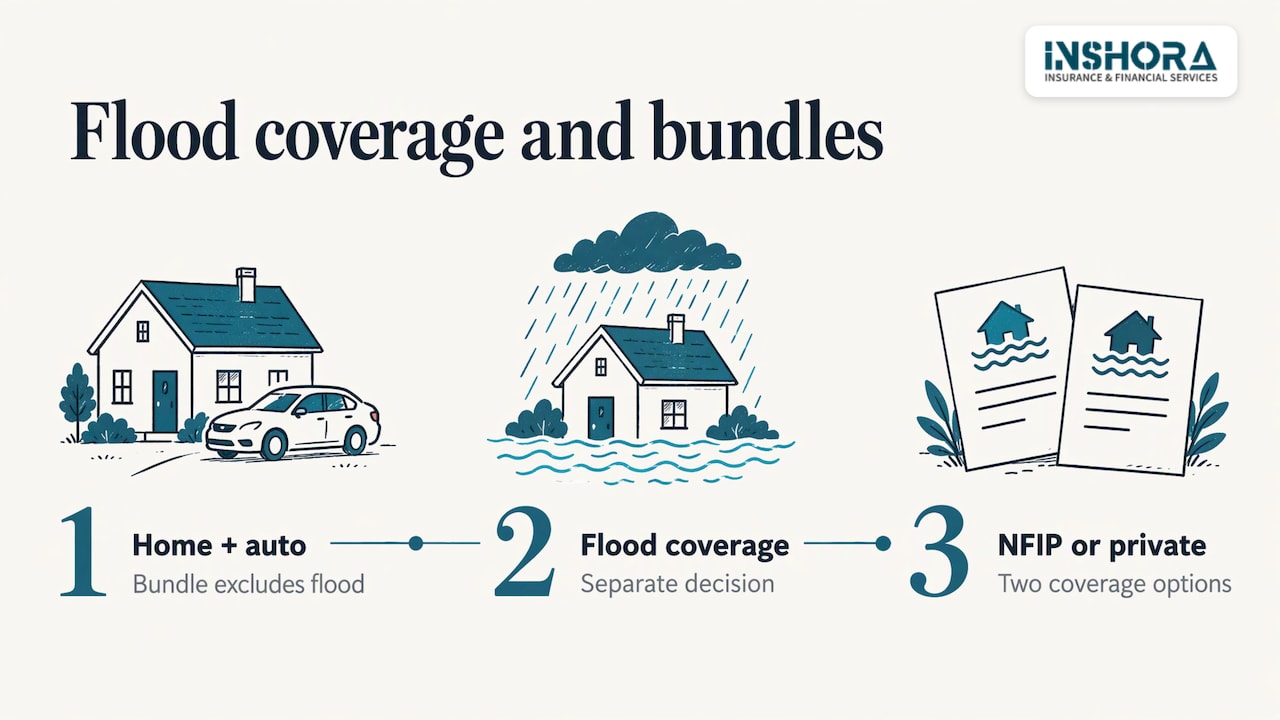
No. Standard homeowners policies exclude flood damage, and a bundle with an auto policy does not change that. In Texas, where hurricanes and heavy rain events are a real part of Gulf Coast life, flood coverage is a separate decision. Our Houston-area clients in Sugar Land, Richmond, Katy and Cypress should treat it as a standard part of the home insurance conversation.
What are FEMA flood zones?
FEMA’s flood maps divide areas by flood risk. Zones starting with A or V are the higher-risk special flood hazard areas, and zones such as X are lower to moderate risk. A lender typically requires flood insurance for a federally backed mortgage on a home in a high-risk zone. Being in a lower-risk zone does not mean being safe, as flooding can occur outside mapped high-risk areas. You can look up a specific address on FEMA’s Flood Map Service Center (msc.fema.gov).
NFIP vs. private flood insurance
| Question | NFIP (federal program) | Private flood |
|---|---|---|
| Who backs it | The federal government through FEMA | Private insurers |
| Where to buy | Through agents and participating insurers | Through agents and insurers that write it |
| Coverage limits | Set by the program | Vary by insurer, may offer higher limits |
| Pricing | Set by program rating | Set by each insurer |
| How to compare | Compare building and contents limits, deductibles, waiting period | Same items, plus replacement cost terms and loss-of-use options |
The specific limits, waiting periods and rates for both change over time, so confirm them on the program’s own site or in the quote documents. We can quote flood insurance alongside your home and auto and set out the options in one comparison.
What if you own a rental home in Texas?
Landlords have a different problem. A standard homeowners policy is written for an owner-occupied house, so a rental property typically needs a landlord or rental-dwelling policy that covers the building and the owner’s liability rather than the tenant’s belongings. Tenants buy their own renters insurance for their contents.
The landlord angles to compare:
- Dwelling coverage and loss of rent. Ask whether the policy pays lost rental income after a covered loss.
- Wind/hail deductible. The same 1%, 2% and 5% math applies to the rental’s dwelling limit.
- Flood. A tenant’s renters policy does not cover the landlord’s building, and a landlord policy usually excludes flood too. If the rental sits in a flood-prone neighborhood, price a separate flood policy for the building.
Bundling a rental property with your own home with one insurer is possible with some carriers, but the combined price should still be tested against separate quotes. Our rental home insurance page explains what we quote, and the rental home insurance overview goes deeper.
How do small claims and deductibles affect your renewal?
A bundle puts both policies with one insurer, so claims on either one can affect how that insurer sees you at renewal. The Kentucky Department of Insurance advises that raising your deductible and paying for small losses yourself, when no other party is involved, may reduce the chance of a rate increase or nonrenewal (Kentucky Department of Insurance). That is Kentucky guidance, and Texas practice varies by insurer, so ask your carrier how it treats small claims.
This is why it pays to decide in advance which losses you would handle yourself. A broken lock or a minor repair, for example, is often cheaper to pay for directly than to claim, and it helps to know what home insurance does and does not cover for locksmith services before you file. Filing for a loss under your deductible gets you nothing anyway.
Are there rules about how bundles are sold?
Yes. The NAIC notes that bundled products can raise issues under state anti-inducement and anti-rebating laws, unfair competition rules, and the unauthorized sale of insurance. Most states look to their version of the NAIC Unfair Trade Practices Act (Model #880), Section H (NAIC). For you as a shopper, the takeaway is that a discount should be tied to the policies you actually buy and described clearly in your quote and policy documents. Read the documents, and ask which discounts are on each policy.
How do you compare a home and auto bundle step by step?
- Set your home coverage first. Choose the dwelling limit, replacement cost or ACV, personal property and liability limits. Use the same numbers in every quote.
- Choose the wind/hail deductible. Get quotes at 1%, 2% and 5%, or flat dollar options, and decide what you can pay after a storm.
- Set your auto coverage. Keep liability limits and deductibles identical across quotes. See our auto insurance page for what we quote.
- Get the bundled quote and separate quotes. Price both routes with the same limits. We compare options from over 25 carriers, which makes this a single conversation rather than a dozen phone calls.
- Check roof terms. Ask how the roof is settled and whether age limits apply.
- Decide on flood. Look up the address on FEMA’s map, then price a flood policy whether or not the lender requires it.
- Read the renewal terms. Ask how discounts are applied and how the carrier handles claims at renewal.
For a deeper checklist, see our guide to comparing homeowners and flood insurance in Texas fairly.
How does Inshora help you compare a bundle?
Inshora Group is an independent insurance agency based in Sugar Land. We compare home, flood and landlord coverage options from over 25 carriers and help Texas households find policies that fit their needs, so you can see the bundled and separate totals together.
Start with a home insurance quote, or read about our Texas home insurance options. Bring your current declarations pages so the coverage, deductibles and roof terms can be matched exactly. Any figures in this article are samples or math examples, not quotes. Your actual price depends on the carrier and your details.
FAQ
Is it always cheaper to bundle home and auto insurance?
No. A bundle discount often lowers the price, but a separate home policy and a separate auto policy can sometimes cost less in total, or give you better coverage. Compare the bundled total with the best separate quotes using the same limits and deductibles.
Do I get one deductible if I bundle?
Not automatically. The NAIC notes that some insurers offer a combined deductible when one event damages multiple insured assets, so ask each carrier whether it is available and how it works (NAIC).
Does a home and auto bundle include flood insurance?
No. Flood is not covered by a standard homeowners policy, and bundling with auto does not add it. Flood coverage is bought separately, either through the National Flood Insurance Program or from a private insurer, and landlords should price it for rental buildings too.
What wind and hail deductible should I choose in Texas?
It depends on what you can pay after a storm. On a $300,000 dwelling limit, 1% is $3,000, 2% is $6,000 and 5% is $15,000 (a math example). A higher percentage usually lowers the premium, so choose the highest amount you could comfortably cover.
Sources
- NAIC: Bundling (Center for Insurance Policy and Research)
- Kentucky Department of Insurance: auto and home rates guidance
