

Startup business insurance is a set of policies that protect a new company from lawsuits, property loss and lost income. Most startups begin with general liability, add coverage for employees or professional work as they grow, and keep the owner’s home and flood policies aligned with where the business actually operates.
TL;DR
- Most small businesses start with general liability insurance, which covers bodily injury, property damage and advertising injury claims.
- If you run the business from a house you own, the home and flood policies are part of the plan, because the building and its contents are the startup’s first assets.
- Hiring your first employee usually triggers workers’ compensation and other employer insurance.
- Compare limits, deductibles and exclusions, not just price. Any rate you see online is a sample, never your quote.
- Inshora Group compares home and flood coverage from over 25 carriers for Texas households.
Table of Contents
- What does startup business insurance actually cover?
- Which types of insurance does a startup usually need?
- How do home and flood insurance fit into a startup plan?
- What if your startup owns a rental property?
- Do you need workers’ compensation when you hire?
- How much does startup insurance cost?
- How do deductibles change what you pay after a loss?
- How do you compare coverage before you buy?
- Why compare through an independent agency?
- What does a first-year insurance checklist look like?
- FAQ
- Sources
What does startup business insurance actually cover?
The FDIC explains that insurance helps a small business manage risk: it can repair or replace property, protect against legal liability, safeguard employees and the public, and replace lost income. A startup is not a special product. It is a combination of the same policies any small business buys, chosen for a company with few assets, few employees and a lot of unknowns.
Three questions sort out most of the decision:
- Where does the work happen? A spare bedroom, a garage, a rented storefront and a customer’s home each carry different property and liability risks.
- Who gets hurt or loses money if something goes wrong? Customers, visitors, employees and clients who relied on your advice are all different exposures.
- What could stop the business from earning? Fire, a storm, a flood or a data breach can all do it.
The Florida Chief Financial Officer’s consumer guide tells owners to start by reviewing property risks (the building, contents, equipment and inventory) and liability risks from premises or operations. That is a good first worksheet for any founder, in Texas or anywhere else.
Which types of insurance does a startup usually need?
The FDIC’s small business guide lists the main building blocks. The table below summarizes them in plain language.
| Coverage | What it covers | Typical early-stage fit |
|---|---|---|
| General liability | Bodily injury, property damage, personal and advertising injury, medical payments, legal fees | Nearly every startup that deals with customers or the public |
| Professional liability (errors and omissions) | Claims of negligence or mistakes in services | Consultants, designers, agencies, other service businesses |
| Business owner’s policy (BOP) | Bundles property, liability and business interruption | Small, low-risk operations that qualify |
| Workers’ compensation | Medical costs and lost income for employees hurt at work | Any business with employees |
| Business auto | Injury and property damage from vehicles used for the business | Businesses that drive for work |
| Cyber liability | Data breaches, ransomware, legal fees, notification costs | Businesses holding customer data |
| Flood | Flood damage, which standard property policies generally do not pay for | Businesses in or near flood-prone areas |
| Umbrella, key person, surety bonds | Extra liability limits, loss of a critical person, contract guarantees | Added as the company grows or contracts require |
Source: FDIC, Module 11 Insurance Participant Guide (2025). Flood and earthquake appear in the same list of coverages a small business may need.
What does general liability pay for?
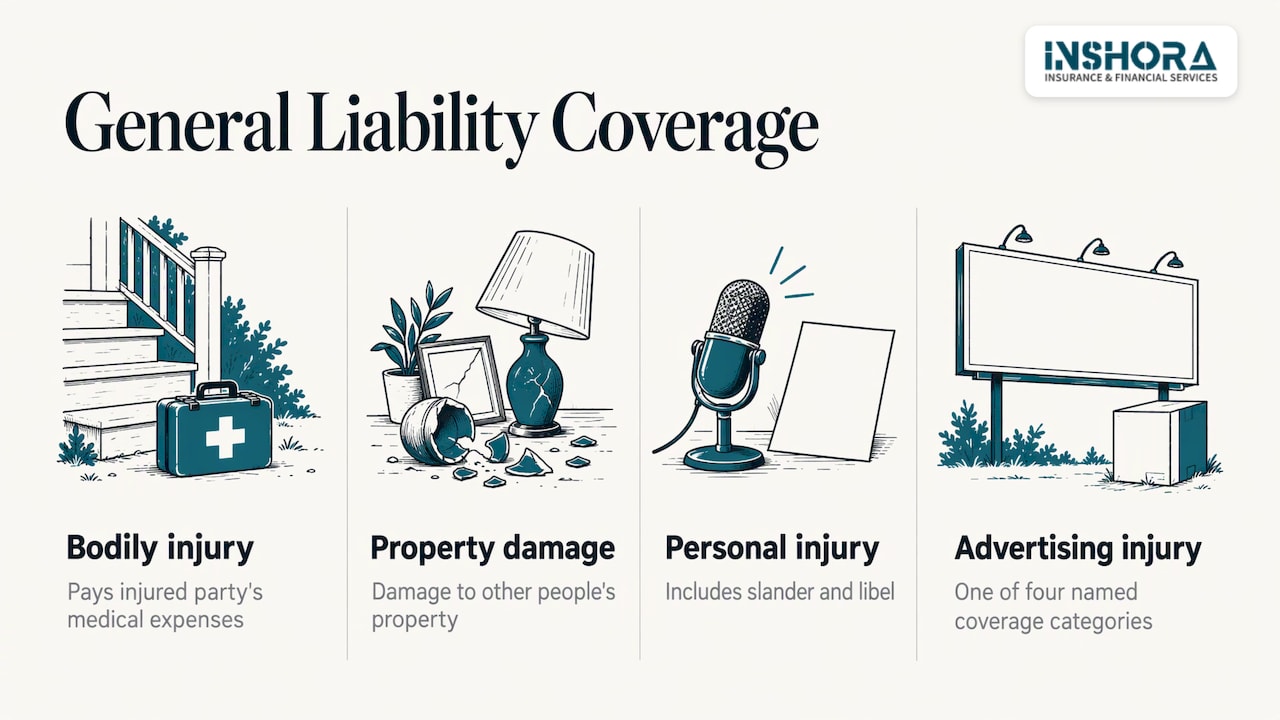
The Wisconsin Office of the Commissioner of Insurance describes commercial general liability as covering four categories: bodily injury, damage to other people’s property, personal injury such as slander and libel, and advertising injury. It also pays the injured party’s medical expenses. If a customer slips on your porch steps during a client meeting at home, this is the policy built for that claim.
What is a BOP, and what does it leave out?
A business owner’s policy packages property, liability and business interruption coverage. The Wisconsin guide notes that eligibility depends on the size of the premises, the limits required, the type of operation and how much off-premises work you do. A BOP does not include professional liability, auto, workers’ compensation, health or disability coverage. Those are bought separately.
What about cyber and crime coverage?
The Maryland Insurance Administration describes crime insurance, fidelity bonds and cyber liability. Cyber coverage may pay for credit monitoring after a security breach, repair or replacement of damaged business assets, and business interruption costs. If you store customer records, small business cybersecurity practices reduce the odds you ever file that claim. Insurance and good security work together.
How do home and flood insurance fit into a startup plan?
Many Texas startups begin at a kitchen table or in a garage. That makes the house the first business location. We focus on home and flood coverage, so this is where we can help most.
A homeowners policy is written around your dwelling, your belongings and your personal liability. A business is a separate exposure with its own equipment, inventory and customers. The FDIC treats property and liability coverage for the business as its own line of protection, which is why founders typically pair a home policy with business coverage rather than expecting one policy to do both jobs. Our business insurance page explains how that second layer works in Texas.
The practical steps for a home-based founder:
- Tell your agent the business exists. Describe what you do, whether clients visit, what equipment you keep and whether you store inventory.
- List business equipment and inventory separately from household belongings, with purchase dates and receipts.
- Ask how each policy treats business activity. Read the exclusions yourself, not just the summary.
- Review flood coverage for the building and contents. More on that below.
You can read about how we handle the homeowner side on our home insurance page, and our guide on how to choose home insurance in Dallas walks through comparing policies in a Texas market.
Why does flood deserve its own line in a startup budget?
The FDIC’s list of coverages a small business may need includes flood as a separate item. That matches how flood works for a home too: it is a distinct policy, not an add-on you can assume. For a founder who keeps laptops, inventory or a workshop at home, one flooded ground floor can end both the household’s and the business’s income at once.
In the Houston area, where many of our clients live and work, that scenario is not abstract. Our guides on how to choose the right flood insurance policy and what flood insurance costs in Houston explain the choices. To start a comparison, use our flood insurance page.
What if your startup owns a rental property?
Some founders fund a startup with rental income, or the business itself is renting out houses. A landlord’s exposure is different from an owner-occupant’s: the tenant’s belongings are the tenant’s, while the building, the landlord’s equipment and the loss of rent are the landlord’s. Our rental home insurance overview and rental home insurance page cover landlord property policies.
Two habits matter for landlords:
- Ask about flood separately for each property. Landlord flood coverage is its own decision, and a rental in a low-lying neighborhood needs the same attention as your own home.
- Match coverage to the lease. If a lease or contract asks you to show proof of coverage, the DISB guide notes that a certificate of insurance is proof of coverage from an insurer, not a guarantee that every issue is covered.
Our guide to the best insurance company for rental property helps frame what to compare.
Do you need workers’ compensation when you hire?
Often, yes. The FDIC says that if you hire employees you are typically required by law to carry additional insurance: workers’ compensation, unemployment insurance and, in some states, disability insurance. The Maryland Insurance Administration explains that workers’ comp is no-fault coverage that provides medical expenses, part of lost wages and rehabilitation costs, and that it is not part of a general liability policy.
The first premium depends on payroll, the jobs employees perform and the industry. After a few years it can reflect your actual loss history. State rules differ, so confirm the Texas requirements for your situation with a licensed agent before your first hire. For the broader picture of early hiring decisions, startup formation steps and pitfalls is a useful companion, and our own page on commercial insurance requirements in Texas covers the Texas side.
How much does startup insurance cost?
No honest article can give you your price. The Maryland Insurance Administration says premiums depend on factors like payroll, classification and industry. The California Office of the Small Business Advocate adds that costs vary considerably by location and that requirements often depend on industry. Any monthly figure you see in an online guide is a sample for a typical business, not a quote for yours.
What moves your price in practice:
- Your industry and what you do for customers
- Where you operate, including flood and storm exposure
- Payroll and the number of employees
- Policy limits and deductibles
- Claims history, once you have one
The same office advises reviewing coverage whenever something significant changes: hiring staff, moving or expanding locations, or adding equipment. A startup changes all three within a year, so plan a coverage check at each.
How do deductibles change what you pay after a loss?
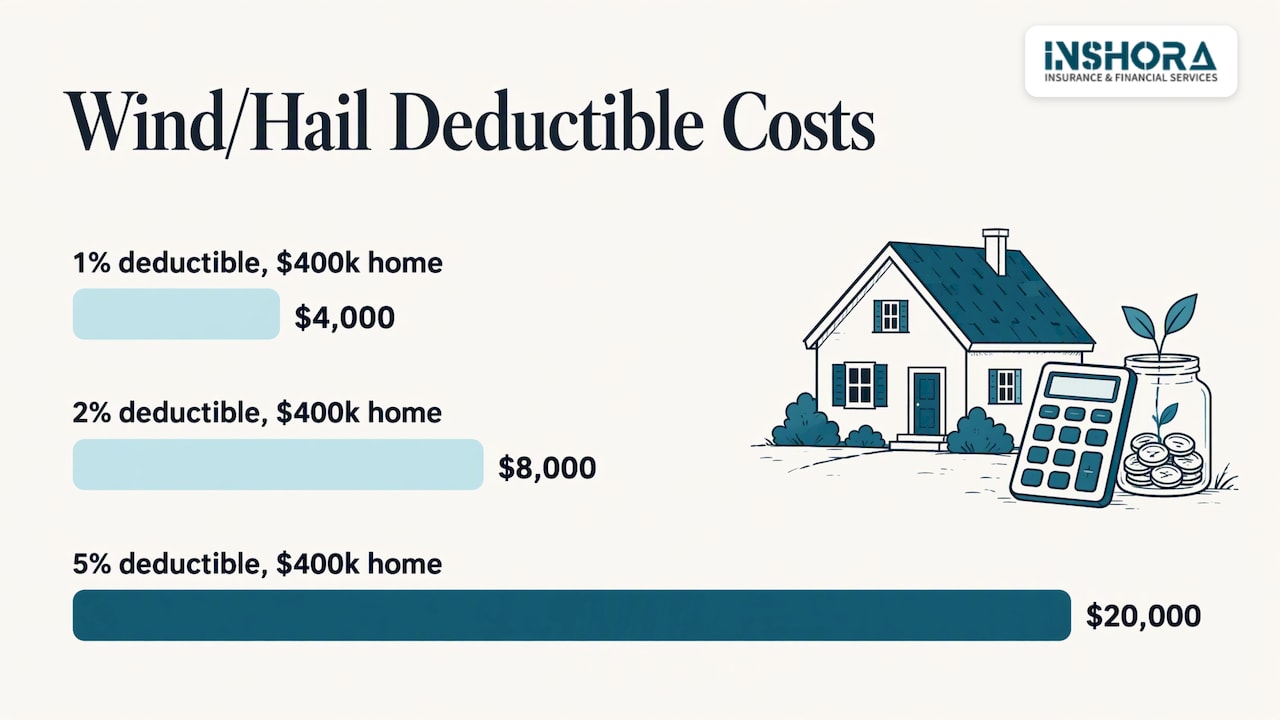
The Wisconsin guide notes that a deductible is the part of a loss you carry yourself, so it advises getting quotes for various deductibles before choosing. On a Texas home, wind and hail deductibles are often a percentage of the home’s insured value rather than a flat dollar amount, so the same storm can leave you with very different out-of-pocket costs.
Here is a mathematical example, not a quote. Assume a house insured for $400,000:
| Wind/hail deductible | Calculation | You pay first |
|---|---|---|
| 1% | $400,000 × 0.01 | $4,000 |
| 2% | $400,000 × 0.02 | $8,000 |
| 5% | $400,000 × 0.05 | $20,000 |
For a startup, the question is whether you could cover that number from savings after a storm, while the business also needs cash. A lower deductible usually comes with a higher premium, and a higher one with a lower premium. Ask for each option side by side and decide with the cash you actually have on hand. Your carrier’s policy documents state the real deductible options available to you.
How do you compare coverage before you buy?
The Wisconsin guide gives a useful reading order for any liability policy:
- Limits. Check the per-occurrence limit, the general aggregate and the separate limits for products and completed operations and for advertising and personal injury. The guide uses a $500,000 single limit with a $5,000 per-person medical limit as an example of how these pieces fit together.
- Deductibles. Get quotes for several, since you carry that amount yourself.
- Exclusions. Read what is left out. The guide lists intentional injury, workers’ comp, professional and auto liability, pollution, contract disputes and product recalls among common exclusions.
- Add-ons. Higher limits or an umbrella policy can be added when the business grows.
Before you sign, the DISB and Maryland guides both stress that a producer’s proposal is only a proposal: the final choice is yours, so ask about any term you do not understand. The DISB guide also recommends working with a licensed producer who can help decide coverage types and how to shop. A useful list of questions is in our article on 10 questions to ask your business insurance agent.
Why compare through an independent agency?
A single carrier can quote only its own policies. Inshora Group is an independent agency in Sugar Land, Texas, and we compare home, flood and landlord coverage from over 25 carriers, including Progressive and Allstate, so you can set coverage, deductibles and prices next to each other in one conversation. Our clients report saving over $600 a year on average.
For a founder, that means one place to line up the home and flood policies that protect the house the business runs from, and the landlord policies for any rentals. When you are ready, start with our home insurance quote form or our home insurance page.
If you want to see the business side too, our business insurance page and quote form are the next step. For an overview first, read what type of insurance is best for a small business.
What does a first-year insurance checklist look like?
- Before launch: list property, equipment and inventory; note where customers meet you; confirm what your home and flood policies say about business activity.
- At launch: put general liability in place, and professional liability if you give advice or deliver services.
- At first hire: add workers’ compensation and review other employer requirements.
- Each time you add equipment or move: update the property values and ask about flood for the new location.
- Every year at renewal: compare coverage, deductibles and prices again rather than auto-renewing.
FAQ
Do I need insurance before I make my first sale?
It is wise to have liability coverage before you serve customers, because a claim can arrive from the first job. The FDIC notes that most small businesses start with general liability. Property coverage matters from the moment you buy equipment or stock.
Does my homeowners policy cover my home-based startup?
A homeowners policy is built around your house, belongings and personal liability. Business equipment, inventory and customer claims are a separate exposure that business coverage like general liability or a BOP is designed for. Ask your agent how your specific policy treats business activity and read its exclusions.
Is flood damage covered by my property insurance?
Flood is listed by the FDIC as its own coverage a small business may need, which means you should confirm it rather than assume it. For your house or a rental, ask for a flood quote alongside the home or landlord policy.
When does my startup need workers’ compensation?
The FDIC says hiring employees typically triggers workers’ compensation and unemployment insurance requirements, with disability insurance in some states. Confirm the Texas rules for your situation with a licensed agent before your first hire.
Is a sample rate the same as my quote?
No. Premiums depend on your industry, location, payroll, limits and deductibles. Only a quote built from your details is your price.
Sources
- FDIC, Module 11 Insurance Participant Guide (2025)
- Maryland Insurance Administration, Commercial Insurance guide
- Wisconsin Office of the Commissioner of Insurance, Consumer’s Guide to Insurance for Small Business Owners (2024)
- DC Department of Insurance, Securities and Banking, Small Business Insurance Guide
- Florida CFO, Small Business Owners’ Insurance Guide (May 2025)
- California Office of the Small Business Advocate, Find Business Insurance
- Small business cybersecurity practices
- Startup formation steps and pitfalls
