

A Texas home is “high risk” to an insurer when its age, condition, location or claims history points to bigger or more likely losses. Insurers can decline or reprice a home for its condition, not for age alone. Comparing several carriers, deductibles and flood options is the fastest way to find coverage that fits.
This guide covers homeowners and landlords in Texas. It is about the house, not the driver: if your search was about hard-to-insure drivers, auto coverage is a separate topic with its own rules.
TL;DR
- Texas insurers may not refuse to renew a home policy based solely on the property’s age, but they may act on its condition: plumbing, heating, air conditioning, wiring or roof.
- Older and historic homes often need updated systems and a careful look at replacement cost versus actual cash value.
- Wind/hail deductibles are often set as a percentage of the home’s insured value, so a 1%, 2% or 5% choice changes your out-of-pocket cost by thousands of dollars.
- Standard homeowners policies do not cover flood. Check your FEMA flood zone and compare NFIP and private flood coverage, whether you own the home you live in or rent it out.
- Comparing quotes from several carriers is the most direct way to see what a hard-to-place home really costs.
Table of Contents
- What makes a Texas home “high risk” for insurance?
- Can Texas insurers refuse my home because it’s old?
- What is an older or historic home policy, and how does it differ?
- Replacement cost vs. actual cash value: which is better for an older home?
- How do 1%, 2% and 5% wind/hail deductibles work?
- What about flood? Why standard homeowners insurance isn’t enough
- How does this apply to landlords with rental properties?
- How are Texas homeowners premiums trending?
- How can I get a hard-to-place Texas home insured at a better price?
- How Inshora Group can help
- FAQ
- Sources
What makes a Texas home “high risk” for insurance?
No single list defines it, but the factors are consistent. The National Association of Insurance Commissioners (NAIC), the group of state insurance regulators, lists the home’s age, claims history, replacement cost, insurance score, deductible and fire-protection class among the things that set a homeowners premium. It adds that newer homes may qualify for discounts, while older homes may not qualify for preferred programs and may need updated heating, plumbing, wiring and roofing.
In Texas, location adds two more layers: severe wind and hail, and flooding. A 1970s house in a Houston-area neighborhood with a 15-year-old roof and a prior water claim can land in a higher-priced tier for several of these reasons at once. The same house with a new roof, updated wiring and a clean claims record can look very different to an underwriter.
Common reasons a Texas home gets labeled high risk:
- An aging roof, especially in hail-prone areas
- Original plumbing, knob-and-tube or older aluminum wiring, or an outdated electrical panel
- Older heating and air conditioning systems
- One or more prior claims, particularly water damage
- A home that is vacant, being renovated or used as a rental
- A location near the coast or in a mapped flood zone
None of these automatically means you cannot get coverage. They mean the quote depends heavily on which carrier you ask, which is why comparison matters.
Can Texas insurers refuse my home because it’s old?
Not for age alone. The Texas Department of Insurance (TDI) publishes a Consumer Bill of Rights for homeowners stating that an insurer cannot refuse to renew a policy based solely on the age of the property. It can, however, refuse based on the property’s condition, such as plumbing, heating, air conditioning, wiring or roof.
The same document sets two protections worth knowing:
- 60 days’ notice before nonrenewal.
- A written statement of reasons when an insurer decides not to insure you.
That written reason is useful. If it says the roof is the problem, you know what to fix, and you know what to tell the next carrier you approach. If you receive a nonrenewal notice, do not wait out the 60 days. Start comparing early so a replacement policy is in place before the old one ends, because mortgage lenders require continuous coverage.
What is an older or historic home policy, and how does it differ?
Standard homeowners policies are written to rebuild a house with modern materials at current costs. Historic homes can break that assumption: plaster walls, old-growth lumber, custom millwork and period details cost far more to restore than a typical rebuild.
The Alabama Department of Insurance describes the HO-8 “Basic Older Home” form as covering 11 named perils and paying repair costs or actual cash value rather than rebuilding costs. It is intended for homes whose historic or architectural features make replacement cost significantly higher than market value. The same page advises insuring a dwelling at replacement value with an automatic inflation adjustment where possible.
Two takeaways for a Texas owner of an older home:
- Ask each carrier which policy form it would use for your house. The form decides how a loss is paid.
- Ask how the carrier calculates the rebuild amount. A figure based on market value can leave a gap if your home has features that are expensive to reproduce.
Houses in older Texas neighborhoods, such as the historic districts in Galveston or older sections of Houston and Richmond, are good examples of where this conversation matters.
Replacement cost vs. actual cash value: which is better for an older home?
This choice shapes what a claim check looks like. Replacement cost pays to repair or rebuild with similar materials without subtracting for age. Actual cash value (ACV) subtracts depreciation, so an older roof or fixture is paid at a reduced amount.
| Feature | Replacement cost | Actual cash value |
|---|---|---|
| How a loss is paid | Cost to repair or replace with similar materials | Replacement cost minus depreciation |
| Effect on an older roof or system | Fuller payment | Reduced payment because of age and wear |
| Premium | Usually higher | Usually lower |
| Best fit | Homeowners who want to rebuild without a large gap | Homes where lower premium matters more than full payment |
| Check on quote | Whether it applies to the dwelling, contents or both | Whether it applies to the roof only (a common carrier choice) |
The last row is the one people miss. Some policies pay roofs on an ACV basis even when the rest of the house is covered at replacement cost. Ask for this to be stated in writing on every quote so you compare like with like.
How do 1%, 2% and 5% wind/hail deductibles work?
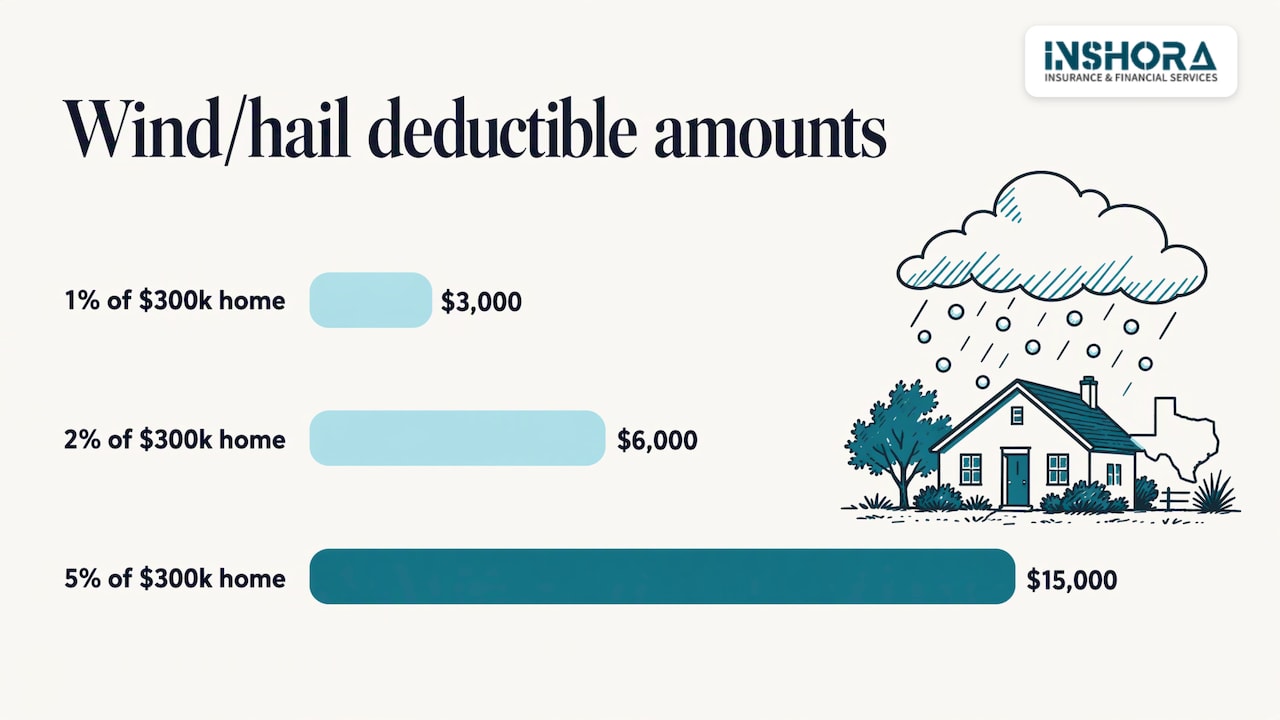
Many Texas policies use a percentage deductible for wind and hail instead of a flat dollar amount. The Oklahoma Insurance Department notes that wind/hail deductibles are typically one or two percent of the insured property value, and says raising a standard deductible to $1,000 can save quite a bit on premiums. The percentage is applied to your dwelling coverage amount, not to the size of the claim.
Here is a mathematical example, not a quote, using a home insured for $300,000 in dwelling coverage:
| Wind/hail deductible | Calculation | You pay first | Insurer pays on a $20,000 roof claim |
|---|---|---|---|
| 1% | $300,000 x 0.01 | $3,000 | $17,000 |
| 2% | $300,000 x 0.02 | $6,000 | $14,000 |
| 5% | $300,000 x 0.05 | $15,000 | $5,000 |
A higher percentage usually lowers the premium, but you must be able to pay that amount out of pocket after a storm. A useful test: if a 5% deductible is more cash than you could gather within a few weeks, a 1% or 2% option may be the safer fit even at a higher price.
When you compare, ask each carrier for the wind/hail deductible as both a percentage and a dollar figure for your specific dwelling amount. A quote that looks cheaper often carries the highest deductible.
What about flood? Why standard homeowners insurance isn’t enough
Standard homeowners policies generally exclude flood damage. In Texas, where heavy rain and tropical storms hit the Houston, Sugar Land, Katy and Cypress area, that gap matters. Flood can affect homes outside mapped high-risk areas, too.
What are FEMA flood zones?
The Federal Emergency Management Agency (FEMA) publishes flood maps that sort areas by flood risk. Zones starting with A or V are the Special Flood Hazard Areas, where the chance of flooding in any year is 1% or higher. Zone X covers lower-risk areas, and lower risk does not mean no risk. You can look up your address on FEMA’s Flood Map Service Center. Mortgage lenders generally require flood coverage for homes in high-risk zones, so your zone also affects your closing and renewal paperwork.
A zone is a starting point. It does not tell you your premium, and it does not account for recent development or drainage changes near your property.
NFIP vs. private flood insurance: how do they compare?
The National Flood Insurance Program (NFIP) is the federal program, backed by FEMA, that offers flood policies through participating agents. Private flood policies are sold by insurance companies outside that program. The differences worth comparing:
| Question to ask | NFIP | Private flood |
|---|---|---|
| Who backs the policy | Federal program | The private insurer |
| Coverage limits | Set by program rules for a home and its contents | Vary by insurer; some offer higher limits |
| Waiting period | Typically begins after a waiting period unless tied to a loan closing | Varies by insurer |
| Pricing | Based on program rating of the property | Based on the insurer’s own underwriting |
| Replacement cost vs. ACV | Rules set by program | Varies; ask for it in writing |
| Where to get it | Through an agent | Through an agent |
Because limits, waiting periods and loss settlement differ by policy, the useful move is to get both kinds of quote for your address and compare them side by side. For a deeper walkthrough, see our guide on how to compare homeowners and flood insurance in Texas fairly and the page on how to choose the right flood insurance policy.
How does this apply to landlords with rental properties?
If you rent out a house, duplex or condo in Texas, your needs differ from an owner-occupant’s.
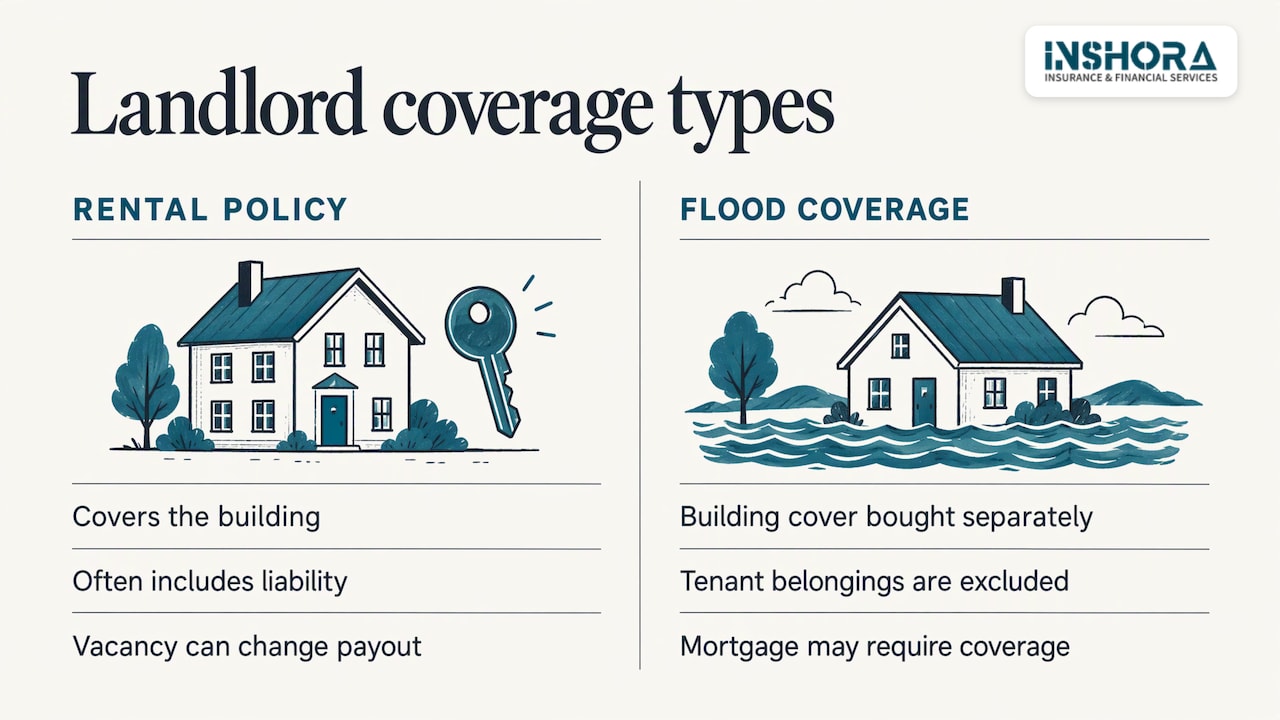
Landlord property coverage. A rental dwelling policy is designed for a home you own but do not live in. It typically addresses the building, and often liability. Underwriters look at the same age, roof and claims factors, plus whether the home is occupied or between tenants. Vacancy can change what a policy will pay, so tell your agent when a unit will sit empty.
Landlord flood coverage. Flood coverage for the building is separate from the rental policy, and your tenant’s belongings are not covered by what you buy for the structure. Tenants need their own renters policy, and flood coverage for their contents has to be arranged separately too. If your rental sits in a high-risk flood zone and has a mortgage, your lender will likely require flood coverage.
Compare rental home insurance options with the same discipline as an owner-occupied policy: roof payment basis, wind/hail deductible, and whether flood is included or purchased separately.
How are Texas homeowners premiums trending?
Texas homeowners have faced rising premiums in recent years, with severe weather and rebuilding costs among the pressures regulators describe. We are not printing a statewide average here, because it changes with each data release and a single figure can mislead about your home. TDI publishes consumer guidance and shopping tips for home and auto insurance, and its HelpInsure resource lets you review how premiums compare. Use those pages for current statewide data, and use real quotes for your own address.
The NAIC notes that premium factors may differ under state laws, which require rates not to be excessive, inadequate or unfairly discriminatory. It also recommends practical ways to lower a bill: shop multiple quotes, raise the deductible, bundle policies, ask about discounts, improve your credit, and check with your state insurance department for roof-upgrade mitigation grant programs and discounts. These are covered on the NAIC premium page.
How can I get a hard-to-place Texas home insured at a better price?
Work through this order:
- Gather the facts. Roof age and material, year of the electrical, plumbing and HVAC updates, square footage and any past claims.
- Fix what an underwriter flags. Since TDI allows action on condition, a documented roof, wiring or plumbing update is the strongest lever you have.
- Decide your deductible range. Choose the highest wind/hail percentage you could actually pay.
- Ask for the loss-settlement basis. Replacement cost or ACV, for the dwelling and separately for the roof.
- Check flood. Look up your FEMA zone and request both NFIP and private options.
- Compare several carriers on the same terms. The cheapest quote is only comparable if limits, deductibles and settlement basis match.
- Keep the written reasons. If a carrier declines, the written statement tells you what to correct before the next application.
How Inshora Group can help
Inshora Group is an independent agency based in Sugar Land, serving Sugar Land, Richmond, Katy, Houston and Cypress. We compare homeowners, flood and landlord coverage options from over 25 top-rated carriers, so one request shows you how different underwriters treat the same house. That matters most for older homes, roofs near the end of their life and properties near flood zones, where carriers can differ widely.
Start with our home insurance page or request a home insurance quote. For flood, the flood insurance page and the flood quote form are the place to begin. Ask us to line up deductibles at 1%, 2% and 5% and replacement cost against actual cash value, so you compare real numbers for your home.

If you are curious about local flood pricing, our article on how much flood insurance costs in Houston explains what drives it.
FAQ
Can a Texas insurer drop my home policy because the house is old?
Not for age alone. TDI’s Consumer Bill of Rights says an insurer cannot refuse to renew based solely on the property’s age, but can act on condition, such as the roof, wiring, plumbing, heating or air conditioning. You are entitled to 60 days’ nonrenewal notice and a written statement of reasons.
Is a 2% wind/hail deductible better than 1%?
It usually lowers your premium but raises what you pay after a storm. On a home insured for $300,000, 1% is $3,000 and 2% is $6,000. Pick the highest amount you could comfortably pay, and compare quotes with matching deductibles.
Does homeowners insurance cover flood damage?
Standard homeowners policies generally do not. Flood coverage is a separate policy, available through the NFIP or from private insurers. Check your FEMA flood zone and get quotes for both before you decide.
Do landlords need flood insurance on a rental house?
A landlord’s property policy does not usually include flood, and tenants’ belongings are not covered by the building policy. If the rental has a mortgage and sits in a high-risk flood zone, the lender will likely require flood coverage. Even outside those zones, many landlords add it for the building.
What is the difference between replacement cost and actual cash value?
Replacement cost pays to repair or rebuild with similar materials without subtracting for age. Actual cash value subtracts depreciation, so older roofs and systems are paid at less. Ask each carrier which basis applies to the dwelling and to the roof.
Sources
- Consumer Bill of Rights for Homeowners, Texas Department of Insurance
- Shopping smart: Tips for buying auto and home insurance, Texas Department of Insurance
- Why are my insurance premiums increasing?, NAIC
- HO-8 Basic Older Home form, Alabama Department of Insurance
- Lowering Your Home and Auto Rates, Oklahoma Insurance Department
